
Biological Safety Cabinets (BSCs) are essential for protecting laboratory personnel, products, and the surrounding environment when handling potentially hazardous biological materials. A critical aspect of their performance is the ability to maintain effective air barrier containment at the cabinet opening, preventing contaminants from escaping the work zone while ensuring operator protection.
As laboratories continue to place greater emphasis on safety, compliance, and performance validation, understanding how containment is tested remains an important consideration for facilities managers, laboratory personnel, and certification specialists.
This article summarises findings from the Air Barrier Containment research project conducted by Maged Shenouda and Sherry Randhawa through the Institute of Medical and Veterinary Science (IMVS) and Flinders University, South Australia. The project examined methods used to validate air barrier containment in Biological Safety Cabinets and compared traditional KI Discus testing with aerosol-based testing approaches.
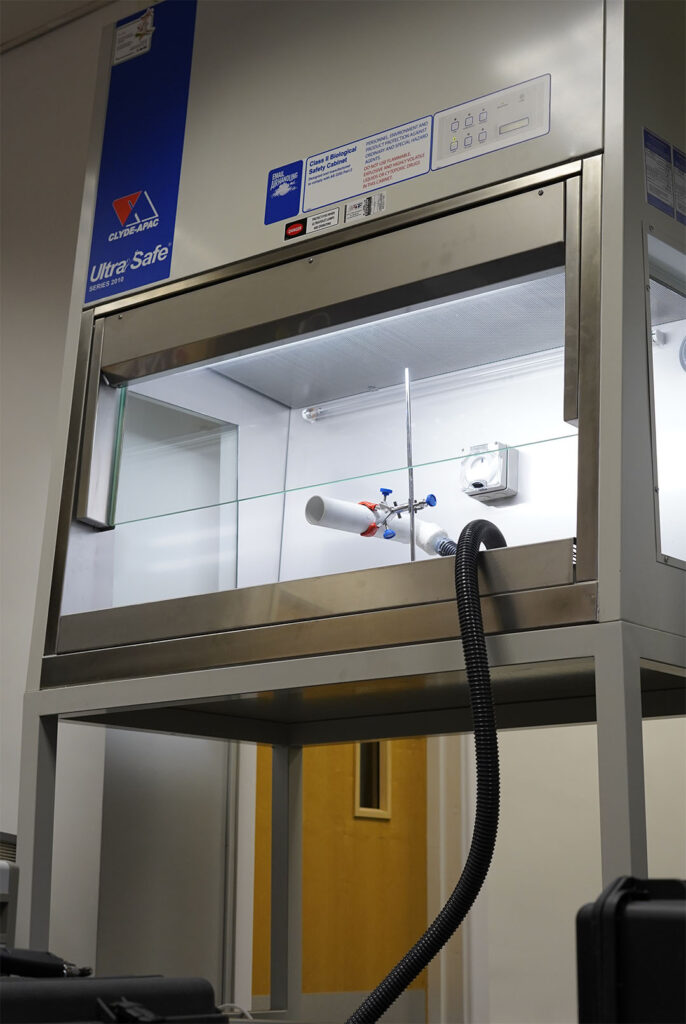
What is Air Barrier Containment?
Air barrier containment refers to the controlled airflow at the front opening of a Biological Safety Cabinet that prevents airborne contaminants from escaping into the laboratory environment.
The effectiveness of this air barrier relies on carefully balanced airflow patterns, including inflow, downflow, and exhaust air. If these airflow patterns are disrupted, containment performance can be compromised, potentially increasing the risk of contamination and operator exposure.
Regular testing and certification help verify that cabinets continue to operate within the required performance paramaters.
Why Containment Testing Matters
Biological Safety Cabinets are designed to provide a high level of protection when handling biological agents and sensitive materials. However, their performance depends on maintaining specific airflow conditions.
Containment testing is used to assess whether the cabinet’s airflow systems are functioning correctly and whether the air barrier is effectively preventing the escape of airborne particles from the work area.
Testing also helps identify airflow imbalances that may affect cabinet performance, enabling corrective action before safety is compromised.
The KI Discus Testing Method
One of the traditional methods used to assess air barrier containment is the Potassium Iodide (KI) Discus test.
This method generates potassium iodide particles and measures their penetration beyond the cabinet’s containment barrier. Results are used to determine operator protection factors and assess the effectiveness of the cabinet under controlled test conditions.
The method has been used extensively within the industry and has contributed significantly to the understanding of Biological Safety Cabinet containment performance.
However, the research identified several practical limitations associated with KI Discus testing, including:
- Equipment costs and setup requirements
- Downtime required to conduct testing
- Potential contamination concerns within laboratory environments
- Fixed sampling locations that may not represent containment performance across the entire cabinet opening
- Larger particle sizes compared with some alternative testing methods
Aerosol-Based Containment Testing
The research also examined aerosol-based testing as an alternative method for evaluating air barrier containment.
Aerosol testing uses fine particles to assess airflow performance and containment effectiveness in real time. The approach enables testing across a broader section of the cabinet opening and can provide valuable insight into airflow behaviour under more representative operating conditions.
The study highlighted several advantages associated with aerosol testing, including:
- Faster test setup and completion
- Reduced disruption to laboratory operations
- Real-time assessment of containment performance
- Consistent particle generation
- Improved visualisation of airflow behaviour
These characteristics make aerosol testing a practical tool for investigating cabinet containment performance and airflow integrity.
The Role of Airflow in Maintaining Containment
One of the key findings of the research was the importance of airflow management in maintaining the air barrier.
The study demonstrated that exhaust airflow plays a significant role in sustaining containment performance at the cabinet opening. Changes to exhaust airflow directly affected barrier performance, while reductions in the main fan airflow increased the potential for disruption to internal airflow patterns.
These findings reinforce the importance of routine maintenance, performance verification, and certification to ensure Biological Safety Cabinets continue to operate as intended.
Key Findings from the Research
The comparison between KI Discus testing and aerosol-based testing suggested that aerosol testing can provide a practical and informative method for evaluating air barrier containment performance.
The study concluded that aerosol testing offered several operational advantages while providing valuable information regarding airflow behaviour and containment effectiveness.
While testing requirements vary depending on applicable standards, certification protocols, and local regulations, the findings demonstrate the value of aerosol-based approaches as part of the wider assessment of Biological Safety Cabinet performance.
Supporting Laboratory Safety Through Performance Verification
Effective containment validation remains an important element of Biological Safety Cabinet certification programmes. By understanding airflow behaviour and regularly verifying containment performance, laboratories can help maintain the protection of personnel, products, and the wider environment.
Testing, maintenance, and certification activities should always be carried out in accordance with applicable standards, manufacturer recommendations, and site-specific requirements.
Research Source
This article is based on the Air Barrier Containment research project by Maged Shenouda and Sherry Randhawa through the Institute of Medical and Veterinary Science (IMVS) and Flinders University, South Australia. The original research poster is available below as a technical reference document.