
It is evident that a direct link exists between clean air and better health, and within universities, the right of students and staff to breathe clean air has never been more important. As awareness continues to grow, institutions are increasingly focused on ensuring that the air within their buildings is not only clean, but proven to be so through independent, third-party ILAC-accredited testing.
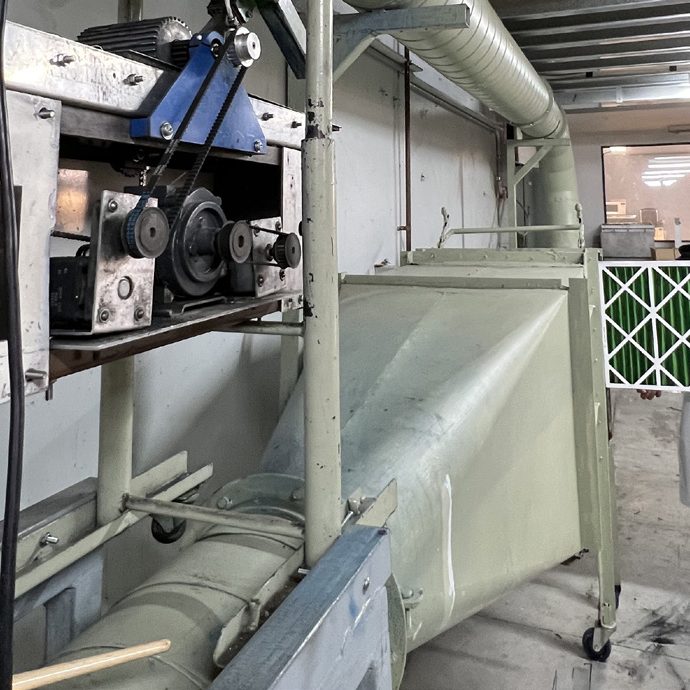
To meet that need, AES operates a fully ILAC-accredited ISO/IEC 17025 testing facility, built around a highly specialised test rig capable of evaluating all brands and types of air filters to globally recognised standards.
This case study explores how AES established this capability, why ILAC accreditation matters, and how it enables organisations to make safer, more informed decisions about the filtration systems they rely on.
Industry Challenge: A Need for Standardised, Cross-Brand Validation
As filtration technologies continue to evolve, so too do the challenges facing both manufacturers and end-users. Different manufacturers often rely on their own preferred testing methodologies, which can vary significantly in rigour and approach. This inconsistency makes it difficult for buyers to compare filters like-for-like, even when products appear similar on paper. At the same time, the number of independent, accredited laboratories capable of testing high-efficiency filters to recognised international standards remains limited, restricting access to accredited performance data. Adding to this complexity, regulatory bodies around the world are increasing their expectations and requiring more robust, traceable evidence to demonstrate that filtration systems are suitable for use in critical environments.
For organisations operating in critical environments, relying solely on manufacturer-supplied data is rarely enough. They require independent, impartial, scientifically validated testing that stands up to regulatory scrutiny.
AES’ Solution: A Fully ILAC-Accredited ISO/IEC 17025 Facility
AES invested in the development of a state-of-the-art filtration test rig, designed and accredited to meet the requirements of ISO/IEC 17025, the global benchmark for laboratory competence.
Why ILAC Accreditation Matters
AES’ accreditation is recognised internationally through the ILAC Mutual Recognition Arrangement (MRA), which ensures that accredited laboratories operate to shared global standards of competence and reliability (IEC 17025). As a result, the test results produced by AES are accepted worldwide, giving customers confidence that the data will be recognised across borders and within regulated sectors. The accreditation also confirms that the laboratory’s methods have been independently evaluated, demonstrating that testing is carried out with technically sound procedures.
Furthermore, all calibrated equipment is required to maintain full traceability to international standards, ensuring accuracy and consistency across every test. Reporting is governed by strict, validated processes designed to eliminate ambiguity and provide complete transparency. Because of this, the data generated by AES is effectively “audit-ready,” meeting the expectations of regulators and quality professionals in industries where documentation, traceability, and scientific integrity are essential.
For customers, this translates into absolute confidence in the accuracy, repeatability, and impartiality of every test AES performs.
What the Test Rig Can Do
AES operates an ILAC-accredited air filter test rig specifically designed for the performance evaluation of HVAC air filters in accordance with internationally recognised standards, including ISO 16890 (Parts 2, 3 and 4) and AS 1324.2. The facility enables comprehensive, third-party testing to support both performance verification and lifecycle assessment.
The rig is capable of measuring gravimetric efficiency across a particle size range of 1–10 microns, providing clear insight into a filter’s overall mass-based removal performance. In addition, fractional efficiency testing for particles below 1 micron allows for a more detailed understanding of filtration behaviour in the finer particle ranges that are increasingly associated with health and indoor air quality concerns.
To support long-term performance assessment, the system also evaluates dust holding capacity, enabling lifecycle analysis of filters as they load over time. This includes measurement of initial and final pressure drop, allowing engineers and estate teams to understand how filter resistance changes throughout its service life and how this may impact system energy consumption and airflow performance.
Testing can be conducted using the controlled discharge of synthetic dust media, ensuring repeatable, standardised loading conditions and consistent results. Because the rig operates under ILAC-accredited methods, filters from any manufacturer can be tested using the same validated procedures, supporting objective comparison and evidence-based procurement decisions.
Benefits for UK and International Clients
With ILAC-accredited testing, organisations gain a level of assurance that is difficult to achieve through manufacturer data alone. They receive trusted, globally recognised test results that can be relied upon across different regulatory environments and international markets. This helps to significantly reduce the validation burden during audits and compliance assessments, as accredited reports carry inherent credibility and meet the expectations of regulators, quality teams, and independent auditors.
ILAC accreditation also ensures that filters from different brands can be compared on a completely neutral and consistent basis, allowing organisations to make procurement decisions using objective, like-for-like data rather than relying on marketing claims or differing test methodologies. This independent verification provides far greater certainty when onboarding new products or evaluating alternative suppliers, reducing risk and helping teams avoid costly performance issues further down the line.
Ultimately, accredited testing supports improved environmental and process control by ensuring that filtration systems perform exactly as required in real operating conditions. This level of validation is essential for any organisation that depends on stable, reliable air quality to protect people, products, or research outcomes.
Accredited testing is not simply reassurance; it is a safeguard that protects people, processes, and regulatory standing.
Accreditation as a Safeguard, Not a Checkbox
AES’ ILAC-accredited ISO/IEC 17025 test rig represents one of the most advanced, impartial air filtration testing capabilities available. By enabling cross-brand, fully validated testing under internationally recognised standards, AES delivers a level of assurance essential to industries where air quality cannot be compromised.
Whether evaluating a new supplier, validating performance claims, or conducting routine QA audits, organisations can rely on AES for accurate, unbiased, globally credible filtration testing.